
The 2008 Mortgage Crisis: Foreclosures and the Bank Bailout
2 min Machine translated About United States Money & business
2 min Machine translated About United States Money & business
The bank says if I don't pay the mortgage, I could lose my house.
Yeah. So if I owe money, that's my problem.
Depends how much money you owe. What? Hmm, look at this, you naive little pig.
The United States, 2008. For years, banks had issued millions of mortgages.
Many ended up with people whose income was unstable or with loans that became harder to repay over time.
But those mortgages didn't always stay at the bank.
They were pooled, turned into financial products and circulated throughout the system.
As long as home prices kept rising, everything seemed to work, until it didn't.
Prices began to fall, many families fell behind on their payments and the mortgages began to generate enormous losses.
By mid-2008, more than one million mortgages were already in foreclosure proceedings.
Families were losing their homes, companies were laying off workers, and credit was starting to freeze up.
Then the problems reached the banks, too.
Major institutions began to collapse. Lehman Brothers went bankrupt, and others were on the brink.
The government decided that letting the whole system fail could drag down the rest of the economy.
In October 2008, Congress authorized an emergency program worth up to 700 billion dollars.
Some of that money went directly toward strengthening financial institutions.
And that's when a contradiction appeared that was hard to ignore.
When a family couldn't pay its debt, it could lose its home.
But when enough banks were in trouble at the same time, their losses no longer threatened only their owners, they threatened the entire system.
There were also programs to help homeowners, but the financial bailout happened on a scale that no family could receive individually.
So if I can't pay a mortgage, I can lose my house.
Yes. But if enough banks get into trouble— Then they don't call it your debt anymore, they call it a risk to the entire system.
End of transcript · 321 words · machine translated
El banco dice que si no pago la hipoteca, puedo perder mi casa.
Sí. Entonces, si debo dinero, el problema es mío.
Depende de cuánto dinero debas. ¿Cómo? Mmm, mira esto, cerdito ingenuo.
Estados Unidos, 2008. Durante años, los bancos habían concedido millones de hipotecas.
Muchas terminaron en manos de personas con ingresos inestables o con préstamos que se volvían más difíciles de pagar con el tiempo.
Pero esas hipotecas no siempre se quedaban en el banco.
Se agrupaban, se convertían en productos financieros y circulaban por todo el sistema.
Mientras las viviendas seguían subiendo de precio, todo parecía funcionar, hasta que dejaron de hacerlo.
Los precios comenzaron a caer, muchas familias se atrasaron en sus pagos y las hipotecas empezaron a generar enormes pérdidas.
Para mediados de 2008, más de 1 millón de hipotecas ya estaban dentro de procesos de ejecución hipotecaria.
Familias perdían sus casas, empresas despedían trabajadores y el crédito empezaba a congelarse.
Entonces, los problemas llegaron también a los bancos.
Grandes instituciones comenzaron a caer.
Lehman Brothers quebró y otras quedaron al borde.
El gobierno decidió que dejar caer todo el sistema podía arrastrar al resto de la economía.
En octubre de 2008, el Congreso autorizó un programa de emergencia por hasta 700 000 millones de dólares.
Parte de ese dinero fue destinado directamente a fortalecer instituciones financieras.
Y ahí apareció una contradicción difícil de ignorar.
Cuando una familia no podía pagar su deuda, podía perder su casa.
Pero cuando suficientes bancos tenían problemas al mismo tiempo, sus pérdidas ya no amenazaban solamente a sus dueños, amenazaban al sistema entero.
También existieron programas para ayudar a propietarios, pero el rescate financiero ocurrió con una escala que ninguna familia podía recibir individualmente.
Entonces, si yo no puedo pagar una hipoteca, puedo perder mi casa.
Sí. Pero si suficientes bancos se meten en problemas- Entonces ya no lo llama tu deuda, lo llaman riesgo para todo el sistema.
 1:58 Biometric Data, Cash Payments and Banking Risks
 1:36 Gabriel Faces Removal from the Company as His Family Worries About Begoña
 1:51 Doña Marta Offers Paula a Manager Position in Granada
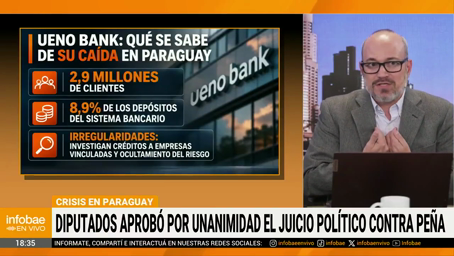 2:33 Bueno Bank Intervention in Paraguay: Loans and Pension Funds
 3:21 The Başaran Family, Habaş and Worker Safety
 3:23 Sock Livestream: Seven-Pair Gift Boxes and Limited-Time Deals
 3:45 How Pakistan Border Closures Hurt Kandahar Farmers and Traders
 2:37 How a Stronger Dollar Affects Fuel, Food Oil and Phones in India
 1:57 Unemployment and a Comparison of Working Life in Pakistan
 1:27 Call to Control Cooking Gas Prices in Tur Al-Baha
 0:38 Yalda Night Sale Prices and a Surprise for Shoppers
 2:04 Yoon Hee-jun’s Viral Moment Boosts Taegang Group Sales
 iPhone app Translate videos on your iPhone Paste a TikTok, Instagram or X link, add subtitles in your language and save the video to Photos.

TranslateMom transcribes and translates videos from X, TikTok, YouTube and Instagram. Paste a link and you get a page like this one, in your language.