At its core, dubbed content is simply a video where the original dialogue has been swapped out for a new audio track in a different language.
You can think of it like giving a movie a whole new voice. This lets people all over the world watch and get lost in the story without having to read a single line of text.
Understanding What Dubbed Content Really Means
Good dubbing is an art form. It’s all about creating an experience that feels completely natural for the new audience, as if the actors on screen were speaking their language from the very beginning.
This goes way beyond just a word-for-word translation. The real work is in matching the new dialogue's tone, emotion, and—when done really well—even syncing up with the original actor's lip movements. It's what makes the content feel immersive instead of distracting. The viewer can just sit back and absorb the story instead of splitting their attention between the action and the text at the bottom of the screen.
This is a huge departure from other video translation methods. If you're curious about the alternatives, you can get a better sense by exploring the meaning of closed captions. For any creator looking to take their content global, knowing the difference is the first critical step.
Dubbing vs Subtitles At a Glance
So, when it comes down to it, should you dub or subtitle? It's a classic debate. Here’s a quick rundown to help you see the core differences at a glance.
| Aspect | Dubbed Content | Subtitled Content |
|---|---|---|
| Viewer Experience | Immersive and effortless; no reading needed. | Requires active reading, splitting attention. |
| Accessibility | Great for viewers who are visually impaired or multitasking. | Demands strong literacy and constant visual focus. |
| Production Effort | Needs voice actors, script adaptation, and audio mixing. | Involves transcription, translation, and text timing. |
| Audience Preference | Often preferred in regions used to localized media (e.g., Germany, Spain). | Favoured by purists who want to hear the original audio. |
Ultimately, the choice depends on your audience and your goals. Dubbing offers a seamless, "lean-back" experience, while subtitles preserve the original performance for those who value authenticity.
Exploring the Different Types of Dubbing
So, what does "dubbed" actually mean when you're in the trenches creating content? It's not a one-size-fits-all answer. Think of it as a spectrum of techniques, each with its own flavour, designed for different kinds of videos and audiences. The path you pick really changes how people connect with your work.
The one most people think of is lip-sync dubbing. This is the big-budget, Hollywood blockbuster approach, where the aim is to make the viewer forget they're even watching a translated film. It’s a painstaking process. Scripts are translated and then adapted so that voice actors can time their lines to match the original actor's lip movements. When it’s done right, it's practically seamless.
Voice-Over and Lector Styles
Then you have voice-over dubbing, which you've probably heard in documentaries or news interviews. It's often called "UN-style" dubbing. With this method, you keep the original audio track but lower its volume, letting it play faintly in the background. A narrator then speaks the translated script over the top. This keeps the authentic emotion of the original speaker intact while making sure the message gets across.
A more direct, no-frills approach is lector dubbing, which is quite popular in parts of Eastern Europe. Here, a single narrator reads all the translated dialogue—for every character—in a steady, unemotional voice. It's not about immersion, but it's a super quick and budget-friendly way to get content localized for certain markets.
This quick comparison breaks down the two main ways to localize your video content—dubbing vs. subtitles—and shows where each one shines.
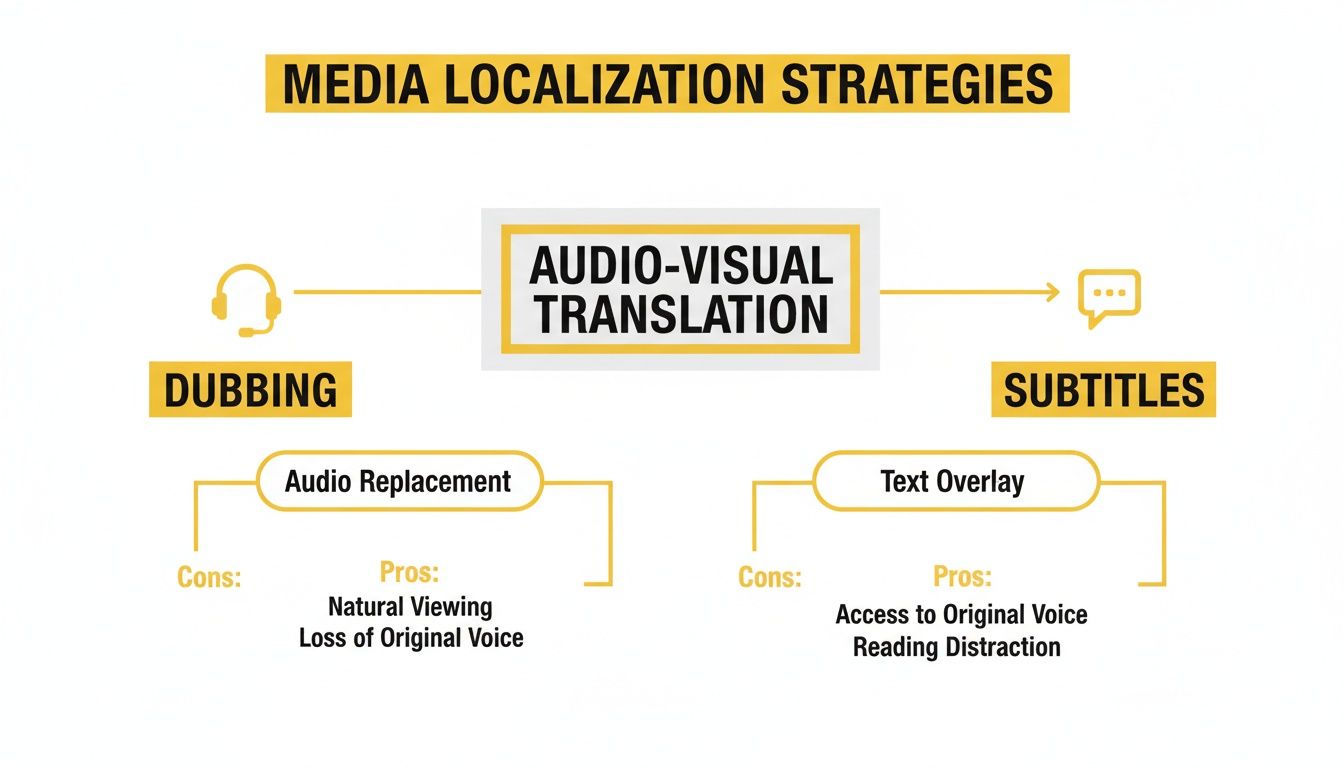
As you can see, dubbing is all about creating an easy, audio-first experience. Subtitles, on the other hand, keep the original audio front and centre, using text to bridge the language gap. Nailing down these differences is the first step in picking the right game plan to take your content global and really connect with viewers everywhere.
Why Dubbing Is Your Key to Global Reach
Deciding to dub your content isn't just a technical choice—it's a direct investment in growing your audience. It smashes through language barriers, making your message instantly land with millions of new viewers who might have otherwise just scrolled on by.
This single move also massively improves the viewing experience for anyone who is visually impaired, prefers listening over reading, or just likes to watch videos while doing other things. Think about it: when someone hears your message in their own language, it creates an immediate, effortless connection that subtitles alone just can't match. That's the stuff that turns a passive viewer into a true fan.
Building Trust Through Localization
When you localize through dubbing, you're meeting your audience where they are. It’s a clear signal that you’ve made a genuine effort to understand and respect their culture, and that builds a deep level of trust. To really get why this is so powerful, it helps to understand the broader benefits of video marketing.
And the numbers back this up. The global dubbing market is on track to hit a massive $9.67 billion by 2033, a boom driven by streaming giants and a huge surge in online education. This shows a clear, undeniable demand for content that feels like it was made just for the local viewer.
Offering a dubbed version of your video is a powerful statement. It tells a global audience, "This content was made for you," fostering loyalty and engagement that text on a screen simply can't match.
At the end of the day, dubbing transforms your content from a monologue into a worldwide conversation. If you're ready to expand your reach, check out our guide on how to translate videos and start connecting with new audiences today.
How AI Is Making Professional Dubbing Accessible
Not that long ago, getting a high-quality dub was something only major studios with deep pockets could even think about. The whole process was a huge undertaking—you had to cast voice actors, book expensive recording studios, and hire sound engineers for weeks, sometimes months.
This created a massive wall for independent creators and small businesses. It basically locked their content out of global markets. But artificial intelligence has completely flipped the script, putting professional-grade tools right into the hands of pretty much everyone.
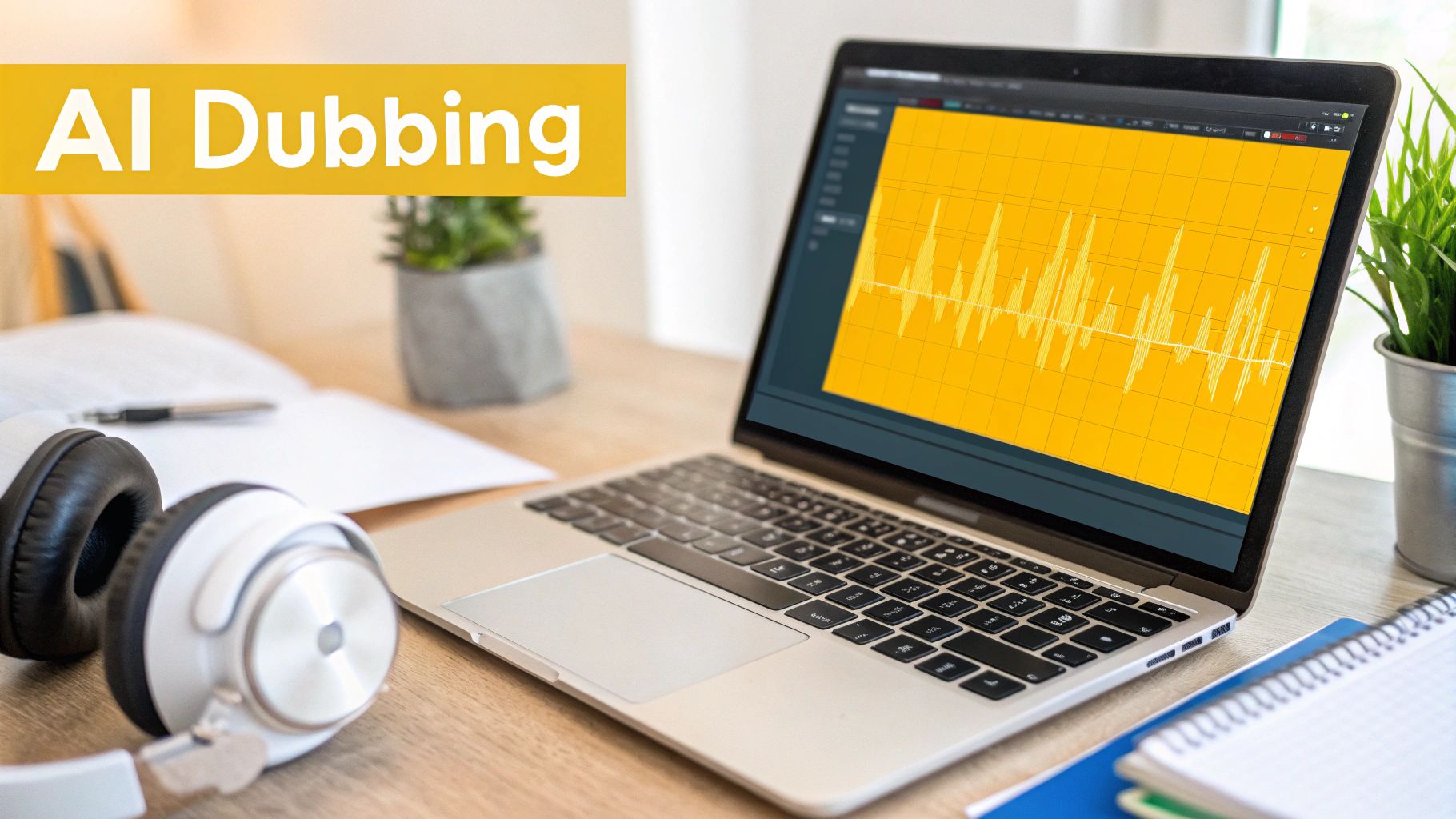
AI-powered platforms can now transcribe, translate, and generate natural-sounding voice tracks in just a few minutes. A huge piece of this puzzle is the incredible progress in AI voice cloning technology, which makes it possible to create dubbed audio that sounds shockingly realistic. This shift has slashed costs and crunched production timelines from months down to mere hours.
The New Era of Dubbing
But this tech isn't just about moving faster; it's about opening doors. Platforms like TranslateMom handle the entire workflow with sophisticated models. All you have to do is upload your video file or even just paste a YouTube, TikTok, or Instagram link, and it takes care of the rest, right up to a fully dubbed final cut.
The rise of AI dubbing means creators are no longer limited by their budget or where they live. It’s making localization a tool for everyone, allowing a powerful message to find a global audience, no matter how big or small the creator is.
This kind of streamlined process gets rid of the biggest headaches that once stood between creators and their international viewers. Forget about complex logistics. Now, you can just focus on your message. If you’re curious about how these tools work, checking out an AI video translator is the perfect place to start.
What you get is consistent, high-quality audio that opens up your content to entirely new cultures and communities. What used to be a complicated, pricey ordeal is now a straightforward strategy for any creator who wants a worldwide presence. It’s completely changing the answer to "what does dubbed mean" for the better.
Your Practical Guide to AI Dubbing with TranslateMom
Alright, enough theory. Let's walk through the simple, step-by-step workflow for dubbing a video using an AI platform like TranslateMom. The entire process, from upload to a final, shareable video, is designed for speed and efficiency.
Everything starts on the New Task screen. You have two ways to bring your video into the system: either drag and drop a file directly into the browser or paste a link from major platforms like YouTube or TikTok.
Pro Tip: Want to work even faster? Just press
Fon your keyboard while on the New Task screen. It’ll instantly open the file picker so you can select your video.
Setting Up Your Dubbing Project
Once your video is uploaded, you’ll choose your settings. This part is super straightforward.
- Source Language: Select the language currently spoken in the video.
- Target Language: Pick the language you want for the new dubbed audio.
- Choose a Service: From the list of options, select Dubbing to generate a new AI audio track.
After you confirm, the platform’s AI gets to work transcribing, translating, and creating the new audio. In just a few moments, your project will appear in the Studio editor, ready for you to review and refine.
Here's what the TranslateMom Studio looks like—it's a full "Studio" environment designed to give you precise control over every element.
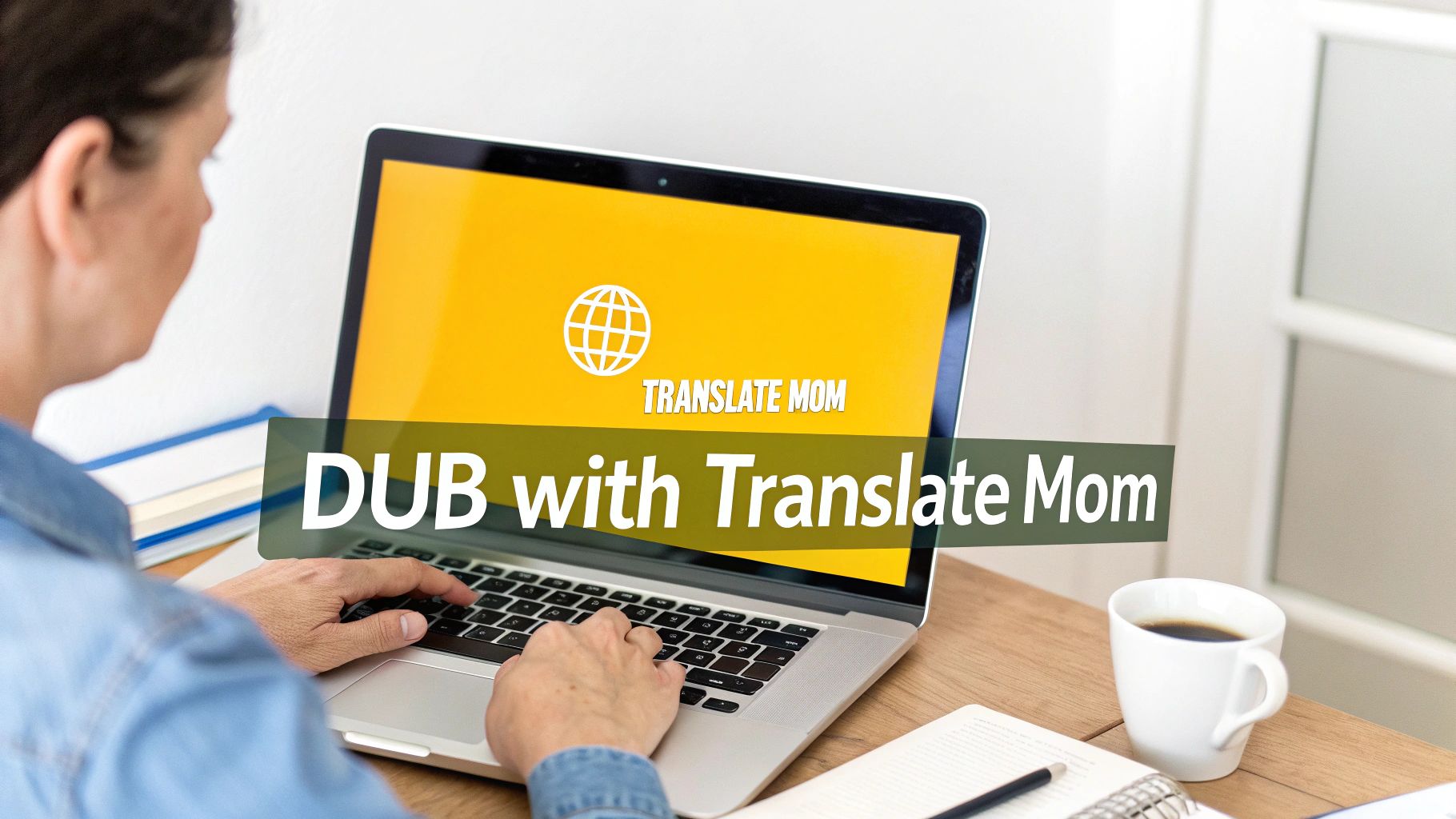
The Studio is a powerful workspace. It features a special video player that accurately previews your subtitles and a timeline editor. On the right, you can edit text, adjust timing using precise inputs, or even drag start/end points on a visual audio waveform to match speech patterns perfectly.
Finalizing and Exporting Your Video
The Studio is where you can listen to the AI-generated dubbing and fine-tune the translated text. The editor allows you to adjust the timing and wording with precision, so you can be sure the final version is exactly as you want it. For extra accuracy, you can even toggle a Split View to see the original source text alongside your translation.
When you’re happy with the result, you have two main export options. You can download just the subtitle files (in standard formats like SRT or VTT) to use in other software, or you can select the Burn-in (Export Video) option. This renders a new video file on the server with your dubbed audio and any custom logos permanently "baked" in.
And just like that, your video is fully localized and ready for a brand new international audience—all done in a fraction of the time and for a fraction of the cost of going the old-school route.
Got Questions About Dubbing? Let's Clear Things Up.
As you start thinking about what dubbed content could mean for your videos, a few questions always seem to pop up. It's totally normal. Getting straight answers is the best way to build a smart localization plan that actually works.
Let’s tackle the most common things creators wonder about when they first look into video dubbing.
Will AI Dubbing Sound Like a Robot?
This is the big one, right? And honestly, it’s a fair question. We’ve all heard those old, clunky text-to-speech voices that sound flat and emotionless. They’re distracting and pull you right out of the video.
But modern AI voice tech is a whole different ball game. Today’s platforms have learned from countless hours of real human speech. They can pick up on natural rhythms, tones, and even the subtle emotions in a voice. The end result is surprisingly human—a voice track that feels smooth, engaging, and totally believable for your new audience.
Is Dubbing Better Than Subtitles for SEO?
This is a classic "it depends" situation. Dubbing and subtitles don't really compete; they help your SEO in different, complementary ways.
- Subtitles are pure gold for search engines. They create a full text transcript of your video, which Google and others can crawl to understand what your content is about and rank it for the right keywords.
- Dubbing is all about the viewer. By making your video easy and enjoyable to watch for people in other languages, you can see a huge boost in things like watch time and audience retention in those countries.
The best strategy? Use both. With a tool like TranslateMom, you can generate the dubbed audio and the translated subtitle file from the same project. This gives viewers a great audio track to keep them hooked and provides a text file for search engines to crawl. It’s the best of both worlds.
What’s This Going to Cost Me?
This is where using AI really flips the script. Traditional dubbing is pricey. You’re paying for studio time, voice actors, sound engineers, project managers... the costs can spiral into thousands of dollars for a single short video.
AI dubbing, on the other hand, makes it incredibly affordable. Instead of all that overhead, platforms usually charge a simple fee based on the length of your video, often per minute. This opens the door for individual creators and small businesses to translate their entire video library without needing a Hollywood budget. That financial wall that used to block you from a global audience? It’s pretty much gone.
Ready to break through language barriers and connect with a global audience? With TranslateMom, you can generate natural-sounding AI dubs in minutes, not months. Start your first project for free and see how simple it is to make your content speak every language. Learn more at https://www.translate.mom.