
Remedios alternativos y cáncer: algas, ozono y peróxido de hidrógeno
94 views 8 min Machine translated Health
En la cara. ¿Qué me pongo en la ca—, eh, en la cara?
Agua y jabón.
Algas. Perdón. Se ha dicho, se ha dicho bastante sobre las propiedades de las algas en cuanto a la desintoxicación.
¿Algas? Algas, algas en general. ¿Qué contienen las algas?
Hay que evitar todos los productos del mar.
Sodio. No. Sí. ¿Y el Essiac? ¿Essiac? Hemos intentado una y otra vez usar Essiac.
No hemos encontrado que sea eficaz en absoluto.
No es perjudicial. Si quieres tomarlo, no me opondría, pero no hemos visto que sea muy útil. Lo siento.
Solo en pacientes con cáncer. ¿Perdón? Solo en personas enfermas.
En personas enfermas, en pacientes con cáncer, sí.
De acuerdo. Sí. Jabón. Perdón. Jabón. ¿Qué jabón usas?
¿Qué jabón usamos? Siempre jabón sin aditivos.
Por lo general, el más barato es el mejor.
Nada de antitranspirante, nada de antiesto ni anti aquello.
Solo filtraciones, barato y sencillo. ¿Jabón de aceite? ¿Aceitoso?
Bueno, el jabón siempre se hace con grasas.
El jabón más sencillo que encuentres. Sí.
Tengo dos preguntas. Una, ¿qué opinas de los huesos de albaricoque?
Opino muy poco de los huesos de albaricoque. ¿De acuerdo?
Se supone que contienen laetrilo. Sí. Pero para obtener, eh, dosis farmacéuticamente eficaces de semillas de albaricoque, eh, laetrilo, tendrías que comer medio kilo o un kilo.
Obtienes demasiado aceite y la, eh, pulpa de la semilla, y frutos secos y demás.
Eso no se debe hacer. Me gustaría hablar contigo del ozono y el peróxido.
Esta es una situación bastante interesante.
Antes de darle algo a un paciente, primero lo pruebo yo.
¿Has oído a algún oncólogo decir eso sobre la quimioterapia?
Me pregunto por qué.
Resulta que el ozono o el peróxido, Son más o menos parecidos. Bien.
Todos saben que el agua es H2O. Dos H y una O, ¿verdad? Eso es agua. ¿Sí?
Bien. Ahora, si agregas una O más, ¿qué obtienes?
Ahora tienes H2O2, y eso es peróxido, ¿verdad?
Pero lo interesante es que aunque el oxígeno tiene dos valencias y suele estar unido con dos, eh, eh, eh, enlaces, por ejemplo, el oxígeno puro, eh, el gas que respiramos todo el día, ¿sí?, tiene, eh, los dos oxígenos, eh,
pero están unidos por un enlace doble, y eso es una sustancia bastante estable.
No se descompone fácilmente. Lo mismo ocurre con el agua.
Es una sustancia muy estable, no se descompone fácilmente.
Ahora añades otra O, y en vez de oxígeno, tienes ozono.
Ahora, en ambos casos tienes una situación similar.
Este oxígeno adicional está unido por un enlace simple.
Igual aquí, un enlace simple. Y como está unido con un enlace simple, se desprende fácilmente, y es muy activo, y extremadamente valioso.
Y eso es lo que usamos. Usamos mucho peróxido de hidrógeno.
Y lo que hace, ¿de acuerdo? Así obtenemos ese radical de oxígeno.
Sí, es un radical libre, pero tiene capacidades maravillosas.
Hace cuatro cosas. No sé si puedo ponerlas todas aquí.
Número uno, mata gérmenes y virus.
¿De acuerdo? Muy bien.
Y número dos, mata el tejido tumoral, el cáncer.
Número tres, oxigena el torrente sanguíneo.
A veces usan cámaras de oxígeno hiperbárico para introducir oxígeno adicional a presión en la sangre, pero es oxígeno, no ozono.
Y en cuanto sales de la cámara, pierdes muy rápidamente ese oxígeno adicional, y todo vuelve a ser como antes.
No ocurre así con el ozono. Ese ozono adicional es mucho más capaz de permanecer en la sangre, y todavía se encuentra allí 72 horas después.
Así que este es, eh, el número tres, oxigena la sangre, por lo tanto, la vuelve más activa.
Y el número cuatro, como es un radical libre, se combina con otros radicales libres y convierte los radicales libres tóxicos en compuestos excretables.
¿De acuerdo? Así que se combina con radicales libres.
Por lo tanto, todo esto, este H2O2 y también el ozono, es un material muy valioso.
Usamos el peróxido. A cada paciente que llega le damos un frasco de peróxido para que se lo frote por el cuerpo todos los días al menos una vez, preferiblemente dos, porque, como cualquier otra cosa que te pones en la piel,
se absorbe directamente en el torrente sanguíneo, y enseguida este radical de oxígeno adicional entra en el torrente sanguíneo.
Y ayuda a matar gérmenes y virus, y ayuda a matar el tejido tumoral, y ayuda a oxigenar y ozonizar la sangre, y ayuda a combinar los radicales libres.
Muy valioso. ¿De acuerdo? Ahora, el ozono también se puede usar, pero es un poco más difícil.
Para el ozono, necesitas un generador de ozono ambiental, que es muy útil, pero es una máquina extra.
Resulta que el peróxido es muy barato. Muy barato, muy eficaz, muy útil.
¿Adivina qué opinan de eso los médicos ortodoxos?
No sirve. Es demasiado barato. ¿De acuerdo?
¿También te lo pones en el cráneo? Porque hablábamos de cómo el cráneo— Sí, ¿por qué quieres ponértelo en el pelo?
Te lo va a decolorar a medias. No lo intentes. No funciona. ¿De acuerdo?
Así que es muy, muy valioso, y cualquier cosa así, que sea inofensiva, solo hace bien, ayuda al paciente, y no tiene por qué ser solo cáncer.
¿Y qué hay de los gérmenes y los virus? ¿Y de la fatiga crónica?
¿Y de todos los demás problemas? ¿Y de los radicales libres?
¿Y de las toxinas? Sí. Eh… Sí, lo sé. Se puede introducir ozono en el torrente sanguíneo.
Me he sometido a esos tratamientos. Pero para que la gente lo haga en casa, es facilísimo.
End of transcript · 926 words · machine translated
On your face. What do I put on my se-- uh, face?
Soap and water.
Seaweed. Sorry. There's, there's been quite a lot said about the properties of seaweed with regards to detoxification.
Seaweed? Seaweed, just general seaweed. What's in seaweed?
All sea products should be avoided. Sodium. No. Yes.
What about Essiac? Essiac? We have tried and tried and tried to use Essiac.
We have not found it to be effective at all.
It's not harmful. If you'd like to take it, I wouldn't fight it, but we haven't found it to be of much value. I'm sorry.
Only on cancer patients. Pardon me? Only on sick people.
On sick people, on cancer patients, yes.
Okay. Yes. Soap. Sorry. Soap. What soap do you use?
What soap do we use? Always soap that has no additives.
Usually the cheapest is best. No antiperspirant, no anti-this, no anti-that.
Just seep-- cheap and simple. Oil soap? Oily?
Well, soap is always made from fats. Just the simplest soap you can find. Yes.
I have two questions. One, what do you think of apricot kernels?
I think very little of apricot kernels. Okay?
They're supposed to have laetrile. Yeah.
But in order to get, uh, pharmaceutically effective doses of apricot seeds, um, laetrile, you would need to eat a pound or two.
You get much too much oils and the, uh, flesh of the seed and nuts and so on.
It's a no-no. I'd like to talk to you about ozone and peroxide.
Now, this is quite an interesting situation.
Before we give anything to a patient, it's me first.
You ever hear an oncologist say that for chemo?
Wonder why.
It happens that either ozone or peroxide, they're more or less similar. Okay.
All of you know that water is H2O. Two Hs and one O, right? That's water. Okay?
Okay. Now, if you add one extra O, and what have you got?
Now you have H2O2, and that's peroxide, right?
But the interesting thing is that while oxygen has two valences and is usually attached with two, uh, uh, uh, bonds, for instance, the plain oxygen, uh, gas that we're breathing all day long, okay, has, uh, the two oxygen, uh,
but they're connected with a double bond, and that's a pretty solid material.
That doesn't break down easily. Same with water.
It's a very solid material, doesn't break down easily.
Now you add another O, and instead of oxygen, you have ozone.
Now, you have a similar situation in both cases.
This additional oxygen is attached with a single bond.
Same here, single bond. And because it's attached with a single bond, it comes off easy, and it's very active, and it's extremely valuable.
And that's what we use. We use a lot of the hydrogen peroxide.
And what it does, okay, so we get that O radical.
Yes, and it is a free radical, but it has wonderful capabilities.
It does four things. I don't know if I can get them all on here.
Number one, it kills germs and viruses.
Okay? Very good.
And number two, it kills tumor tissue, cancer.
Number three, it oxygenates the bloodstream.
Now, sometimes they use hyperbaric oxygen chambers to pressure extra oxygen into the blood, but it's oxygen, it's not ozone.
And the minute you get out of the chamber, very quickly you lose this extra oxygen, and it's the way it was.
Not with the ozone. That extra ozone is much more capable of staying in the blood, and you still find it 72 hours later.
So this is, uh, number three, it ozonates the blood, therefore makes it more active.
And number four, because it's a free radical, it combines with other free radicals and makes toxic free radicals into excretable compounds.
Okay? So it combines with free radicals.
Therefore, this whole thing, this H2O2 and also ozone, is very valuable material.
We use the peroxide. We give every patient when they come a bottle of peroxide to rub on their bodies every day at least once, preferably twice, because like every other thing you put on your skin, it's absorbed right into the bloodstream,
and right away this extra oxygen radical goes into the bloodstream.
And it helps to kill germs and viruses, and it helps to kill tumor tissue, and it helps to oxygenate and ozonate the blood, and it helps to combine the free radicals.
Very valuable. Okay? Now, ozone can also be used, but it's a little more difficult.
For ozone, you need a room ozone generator, which is very useful, but it's a little extra machine.
It happens that peroxide is very cheap. Very cheap, very effective, very useful.
Guess what orthodox doctors think of it?
No good. It's too cheap. Okay? Do you put it on the skull as well?
Because we were talking about how the skull- Yeah, why do you want to put it on your hair?
You're going to bleach it halfways. Don't try. Doesn't work. Okay?
So very, very valuable, and anything like this, which is harmless, does only good, helps the patient, and doesn't just have to be cancer.
How about germs and viruses? What about chronic fatigue?
What about all the other problems? What about the free radicals?
What about the toxins? Yes. Um- Yes, I know.
You can put ozone in the bloodstream. I've had those treatments.
But just for people to do at home, this is so easy.
 0:57 Consejos sobre las mitocondrias y la prevención del cáncer
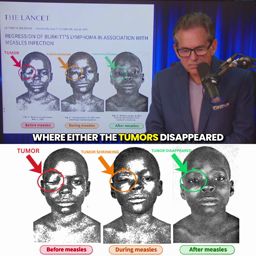 2:51 Sarampión y remisión del cáncer: el caso de un niño en 1971
 4:06 Afirmaciones sobre el ADN en las vacunas y las enfermedades autoinmunes
 4:30 Afirmaciones sobre la microbiota intestinal, los somátidos y el diagnóstico de cáncer
 1:53 Sal y ácido estomacal: afirmaciones sobre el reflujo y el golpe de calor
 2:24 Debate sobre vacunación Amish, autismo y publicidad farmacéutica
 1:03 Aceite de ricino para la visión: afirmaciones sobre sus beneficios
 2:48 Dr. Jeff Barkey habla sobre la seguridad y los ingredientes de Vaxelis
 3:00 El número 33 en los informes de COVID-19: una supuesta agenda oculta
 2:38 ¿Son reversibles los bloqueadores de la pubertad? Debate sobre fertilidad y desarrollo
 1:06 Aceites de semillas industriales: afirmaciones sobre hexano e inflamación
 1:24 Cuestionamientos sobre la muerte cerebral y la extracción de órganos
 iPhone app Translate videos on your iPhone Paste a TikTok, Instagram or X link, add subtitles in your language and save the video to Photos.

TranslateMom transcribes and translates videos from X, TikTok, YouTube and Instagram. Paste a link and you get a page like this one, in your language.