
The Cretan Diet, Omega-3s and the Seven Countries Study
7 min About Greece Health
Talk to us a little bit more about Crete.
So tell-- remind everyone, where is Crete and what is this, the diet of Crete?
What exactly is in it that has all these omega-3s?
Um, okay. Crete is the biggest island in the Southern Aegean in the country of Greece, and, uh, it has probably the oldest civilization in Greece.
First were the Minoans, who were the people in Crete, and then there were the people in the Peloponnese, and there is an argument who came first.
But I, I am from the Peloponnese, and I can tell you, I think the Minoans came first.
But eventually, they were conquered by us, and everything was absorbed.
So that's Crete. They are, um, very family-oriented people, and, um, they maintain a very strong tradition, both in terms within their families as well as with their education, and definitely the food.
So what it is they eat, everything they eat is fresh, and everything is produced there.
And it has a climate that is warmer than the rest of Greece.
Like, they have tomatoes in the winter, they have bananas.
It's not like Northern Greece, which is more like Central Europe. Mm-hmm.
So they're more like a tropical type of, uh, of island.
And, um, they-- The, the reason you hear a lot about the diet of Crete, it's actually very similar to the diet where I come from, from Mani.
But the reason we hear a lot about Crete is because when they did the Seven Countries Study, the part of Greece that they included was Crete.
Mm-hmm. And so they had the best data from Crete.
And the interesting thing is that at that time, Ancel Keys, who was the leader of the, of the Seven Countries Study, did not, um, pay much attention, um, I would say, to the essential fatty acids.
In fact, he never mention- mentioned, and he never measured the omega-6 and omega-3s. Mm-hmm.
So they knew that they were eating fats of different kinds.
They knew that some of that was polyunsaturated fat, but they did not distinguish between the omega-6s and omega-3s.
No, because they stuck with olive oil, and they did not measure, and they did not include it.
And when I was at the NIH, I went back and looked at the data, and I said, "My God, he has not really measured the fish intake."
And what had happened is, as they translate from the English to the Greek, the word fish, there are two different words.
One is psari, which is fresh fish, uh, and the other is like, um, sardines and herring, which is salted or smoked. Mm-hmm.
And the person who was doing the translation then did not, um, find any fresh fish, uh, throughout the island because there were no refrigerations.
The only type of fish they ate was sardines and herring.
And I went back, and I saw, and knowing both languages, I was able to see the mistakes they had made.
And I went, and I said, "We've got to measure.
We've got to measure the omega-6, omega-3 content of the diet of Crete."
And I did that, uh, in, um, around 70, 1970, 1968, 70, before they began to make changes.
And then as I was looking through the old papers, I found out one of his assistants decided to measure, uh, alpha-linolenic acid and linolenic acid in the cell membranes and compare them to the data from Holland.
The guy was from Holland. But Keys did not believe in, in essential fatty acids, and he did not use the data.
And I had spent a year trying to find that if he had published it, I would not have had to do all that.
And so I discovered, you know, then the purslane and all these other things.
And then, not only that, but they had a high amount, and the, and the omega-3s were present in every meal.
And herring and sardines had more omega-3 fatty acids, EPA and DHA, than any fresh fish in Greece.
Hmm. Isn't the irony of the whole thing?
That's why, you know, you have to be very accurate.
And I remember once I was on the same platform with Keys, and he did say, "If you were on my team, they would have discovered the omega-3s."
Wow. So you met Ancel Keys?
Yeah, I, I knew Ancel Keys. What- And he knew that I felt very strong about omega-3s.
Mm-hmm. What was your- Yeah. What's your opinion of him as a researcher?
He's a very polarizing figure. Do you think he was doing good research, honest research, or do you think he was being cavalier?
He's very-- He was very obstinate, and, and he was, he was a person who wouldn't change his mind regardless of data.
And, uh, in 1956, there was, uh, this correspondence in The Lancet between him and one of the professors at Oxford who believed in the omega-3, uh, in, in the, um, uh, polyunsaturated, uh, in PUFAs in general.
And, um, Keys did not want to hear. He only believed in cholesterol.
Yeah, you know, it's important to be able to recognize your mistakes or to get the views of other people and compare.
Mm-hmm. That's why I think the studies that are being done now, they're collaborative studies, they're much better studies because people realize that, you know, you don't know it all.
There are people who know more, or you have a different point of view, and it's important to examine it.
End of transcript · 954 words
 2:20 Concerns Over Smallpox Vaccine Deployment
 2:55 Study Links Carbon Nanodots to Soft Drinks
 1:28 Debate on Vaccines and Autism
 1:38 Debate on Statins Effectiveness
 1:46 Pumpkin Seed and Black Seed Recipe for Prostate Symptoms
 1:50 How to Stop Overthinking: Breathing, Observing Thoughts and Chanting
 2:03 COVID-19 Aftereffects: A Testimony on Freedom and Vaccination
 2:43 Metabolic Health and Weight Loss With Diabetes or Fatty Liver
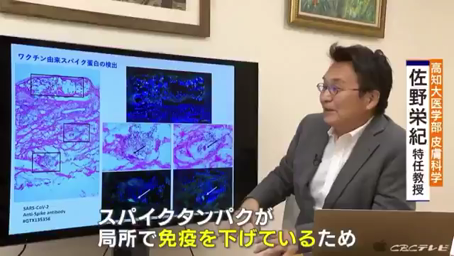 1:12 Professor Discusses Vaccine Spike Protein, Side Effects and Immunity
 1:57 Nobel laureate claims a virus contains HIV sequences
 1:10 Rectal Examination: Hemorrhoids, Anal Fissures and the Prostate
 0:48 Challenges of Developing Influenza and HIV Vaccines
 iPhone app Translate videos on your iPhone Paste a TikTok, Instagram or X link, add subtitles in your language and save the video to Photos.

TranslateMom transcribes and translates videos from X, TikTok, YouTube and Instagram. Paste a link and you get a page like this one, in your language.