
Les quatre chambres des morts dans le Livre d'Hénoch
5 min Machine translated Faith
5 min Machine translated Faith
Ce n'est pas encore arrivé. Leur état est décrit comme bon et leur situation comme inachevée, et ce sont deux faits distincts.
La deuxième chambre abrite les assassinés, et ici, le texte fait quelque chose qu'aucun autre récit antique ne fait.
Il nomme le premier occupant, Abel. Raphaël dit à Énoch que c'est la chambre de ceux qui portent plainte, et que l'esprit d'Abel s'y trouve, réclamant justice contre Caïn.
Et le texte dit que la plainte continue jusqu'à ce que la lignée de Caïn soit détruite de la surface de la terre.
Les esprits ici ne sont pas en repos, et ils ne sont pas punis.
Ils poursuivent une affaire. Leurs morts n'ont jamais été consignées dans aucun registre.
Personne n'a jamais été tenu pour responsable, et il est dit qu'ils crient, ce qui reprend exactement les termes de la Genèse lorsqu'elle dit que, « La voix du sang d’Abel crie depuis la terre. » Alors, ce qui place une personne dans la deuxième chambre,
ce n’est pas le péché. C’est d’avoir été victime d’un péché sans qu’aucun recours ne soit possible.
C’est une catégorie de morts pour laquelle le christianisme occidental, avec ses deux destinations, n’a jamais prévu de place.
La troisième chambre accueille les pécheurs jamais jugés de leur vivant.
Ce sont des gens qui ont fait du mal, sont morts sans en subir les conséquences, et n’ont jamais été traduits devant qui que ce soit.
Le texte dit qu’ils sont mis à l’écart dans une grande souffrance jusqu’au jour du Jugement.
Or, c’est la chambre la plus proche de vos leçons.
Mais regardez ce qui lui manque encore. Il n’y a pas de feu.
Il n’y a ni diable ni démons, ni bourreaux d’aucune sorte, et personne n’y administre quoi que ce soit.
La condition est décrite, et aucun mécanisme n’est décrit, et aucun agent n’est nommé, et il est explicitement indiqué que c’est temporaire jusqu’au jour du Jugement.
La chambre n’est pas le verdict. C’est là que vous êtes retenu avant le verdict, ce qui éclaire l’ensemble du récit.
Chambre un, à l’aise, en attente. Chambre deux, dans l’incertitude, poursuivant une revendication, en attente.
Chambre trois, dans la détresse, en attente.
Trois chambres, trois conditions, une caractéristique commune.
Rien n’a encore été décidé, d’où l’anomalie de la quatrième chambre.
La quatrième division accueille les personnes que le texte décrit comme des pécheurs impies qui étaient les compagnons des iniques.
Et il dit ceci : « Ils ne seront pas mis à mort le jour du Jugement, et ils ne seront pas relevés de là. » Lisez cela deux fois, car ses deux parties sont étranges, et la seconde moitié est plus étrange.
Ils ne sont pas tués. Quel que soit le jugement, il ne s'abat pas sur eux, et ils ne sont pas ressuscités.
Ils ne sortent pas. Nulle résurrection de la quatrième chambre, et il n'y a pas de procès, et il n'y a pas de sentence, car aucune procédure ne les concerne, absolument.
Toutes les autres catégories de morts dans ce récit vont quelque part.
Quelque chose va leur arriver. La quatrième chambre est le seul endroit où rien d'autre n'est prévu.
C'est une idée véritablement différente du tourment éternel, et à certains égards, plus froide.
Le tourment est une relation. Quelqu'un vous fait quelque chose, et vous existez toujours dans le système, on s'adresse toujours à vous.
La quatrième chambre, c'est l'exclusion de la procédure.
L'affaire n'est jamais appelée, et il convient de remarquer quel est le critère énoncé.
Pas l’ampleur du péché, ni le meurtre, ni le vol, ni l’incroyance.
Être impie et être le complice des hors-la-loi.
C’est-à-dire être lié à eux, fréquenter leur compagnie, faire partie de ce qui les soutenait.
Alors, si le récit d’Hénoch sur les morts humains ne parle pas de feu, le livre parle-t-il de feu ?
Oui, et abondamment. Et à qui il est destiné, c’est l’enjeu.
Au chapitre 10, Azazel, l’un des Veilleurs descendus sur terre, est ligoté pieds et poings par Raphaël, puis jeté dans les ténèbres, dans une cavité du désert, recouverte de rochers, le visage couvert, si bien qu’il ne peut pas voir la lumière.
Et au grand jour du Jugement, le texte dit qu’il est jeté dans le feu.
Aux chapitres 18 à 21, on montre à Hénoch un lieu situé aux confins du ciel et de la terre, une prison chaotique, et en son sein brûlent les étoiles de tout là- haut qui ont transgressé le commandement.
Uriel lui dit que c'est la prison des anges, et qu'ils y seront enfermés à jamais.
Et c'est ici que le problème de traduction évoqué plus tôt cesse d'être abstrait.
2 Pierre 2:4 dit que Dieu n'a pas épargné les anges qui ont péché, mais les a précipités et livrés aux chaînes des ténèbres, où ils sont gardés pour le jugement.
Le verbe grec est « Tartarosas ». Il apparaît exactement une fois dans tout le Nouveau Testament, et nulle part ailleurs chez un auteur.
Ce mot n'est pas générique. Il désigne une prison précise.
Et le texte grec d'Hénoch, au chapitre 20, décrit l'ange Uriel comme celui qui est établi sur le monde et sur le Tartare.
Le même—
End of transcript · 868 words · machine translated
Has not happened yet. Their condition is described as good and their situation as unfinished, and those are two separate facts.
The second chamber holds the murdered, and here the text does something no other ancient account does.
It names the first occupant, Abel. Raphael tells Enoch that this is the chamber of those who make complaint, and that the spirit of Abel is there, making suit against Cain.
And the text says the complaint continues until Cain's line is destroyed from the face of the earth.
The spirits in this chamber are not at rest, and they are not being punished.
They are pursuing a case. Their deaths were never entered into any accounting.
No one was ever held responsible, and they are described as crying out, which is exactly the language Genesis uses when it says, "The voice of Abel's blood cries out from the ground."
So what puts a person in the second chamber is not sin.
It is having been sinned against with no remedy.
That is a category of the dead that Western Christianity, with its two destinations, has never had a place for at all.
The third chamber holds sinners who were never called to account in life.
These are people who did real harm, died without consequence, and were never brought before anything.
The text says they are set apart in great pain until the day of judgment.
Now, this is the chamber closest to what you were taught.
But look at what is still missing from it.
There is no fire. There is no devil, no demons, no tormentors of any kind, and there's no one administering anything.
The condition is described, and no mechanism is described, and no agent is named, and it is explicitly temporary until the day of judgment.
The chamber is not the verdict. It is where you are held before the verdict, which brings the whole account into focus.
Chamber one, comfortable, waiting. Chamber two, unresolved, pursuing a claim, waiting.
Chamber three, in distress, waiting. Three chambers, three conditions, one shared feature.
Nothing has been decided yet, which makes the fourth chamber the anomaly.
The fourth division holds people the text describes as sinners who were godless and who were the companions of the lawless.
And then it says this, "They shall not be slain on the day of judgment, nor shall they be raised from there."
Read that twice, because both halves are strange, and the second half is stranger than the first.
They are not slain. Whatever the judgment does, it does not fall on them, and they are not raised.
They do not come out. There's no resurrection from the fourth chamber, and there is no trial, and there is no sentence, because there is no proceeding involving them at all.
Every other category of the dead in this account is going somewhere.
Something is going to happen to them. The fourth chamber is the one place where nothing further is scheduled.
That is a genuinely different idea from eternal torment, and in some ways a colder one.
Torment is a relationship. Someone is doing something to you, and you still exist within the system, still being addressed.
The fourth chamber is exclusion from the proceeding.
The case is never called, and it is worth noticing what the stated criterion is.
Not the size of the sin, not murder or theft or unbelief.
Being godless and being the companion of the lawless.
That is, being attached to it, keeping company with it, being part of what sustained it.
So if Enoch has no fire in his account of the human dead, does the book have fire at all?
Yes, a great deal of it. And who it is for is the whole point.
In chapter 10, Azazel, one of the watchers who came down, is bound hand and foot by Raphael and thrown into darkness, into an opening in the desert, covered with rock, his face covered so he cannot see the light.
And on the great day of judgment, the text says he is cast into the fire.
In chapters 18 through 21, Enoch is shown a place at the end of heaven and earth, a chaotic prison, and in it, burning, the stars of heaven that transgressed the commandment.
Uriel tells him this is the prison of the angels, and they will be confined here forever.
And this is where the translation problem from earlier stops being an abstraction.
2 Peter 2:4 says that God did not spare the angels who sinned, but cast them down and committed them to chains of darkness to be kept for judgment.
The verb in the Greek is Tartarosas. It appears exactly once in the entire New Testament, nowhere else by any writer.
That word is not generic. It names a specific prison.
And the Greek text of Enoch in chapter 20 describes the angel Uriel as the one set over the world and over Tartarus.
The same-
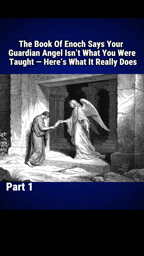 5:00 Les anges gardiens dans la Bible et le Livre d’Enoch
 3:41 Un rabbin et une femme juive devenue catholique débattent de leur foi
 1:27 Starseeds et âmes terrestres : réincarnation et changement de la Terre
 1:45 Musulmans et chrétien débattent du blasphème et de la violence
 1:08 Un catholique parle de foi, d’église et de gratitude
 2:01 Nixon et Billy Graham parlent des Juifs et du contrôle des médias
 4:04 Comment les cinq prières quotidiennes de l’islam rythment la journée
 0:52 Aqida : l’islam présenté comme seule vérité
 2:43 Noé, les Veilleurs et les Apkallu dans Hénoch et les mythes mésopotamiens
 0:57 Le rêve du prophète Muhammad et la femme noire : un récit raciste
 0:45 Débat sur l’islam, les droits des femmes et les valeurs occidentales
 2:20 Fausses affirmations sur le bilan de la Shoah et la prophétie juive
 iPhone app Translate videos on your iPhone Paste a TikTok, Instagram or X link, add subtitles in your language and save the video to Photos.

TranslateMom transcribes and translates videos from X, TikTok, YouTube and Instagram. Paste a link and you get a page like this one, in your language.