
Rubio on a Democratic Congress and US Foreign Policy
2 min About United States Politics
2 min About United States Politics
Mr. Secretary, Martin Sattar, Frankfurter Allgemeine Zeitung, Germany.
I was wondering whether you fear that your job will become more difficult come January when you have to deal with a Democratic Congress.
Do I fear it? Yes. Well, first of all, we haven't had an election yet, so we don't know what Congress will look like. So second of all, no, I mean, look, the foreign policy, Congress has a role to play in foreign policy.
I played it for a very long time as a member of the Senate.
So I understand what Congress can and cannot do with regards to foreign policy.
But when it comes to issues of national security and foreign policy, uh, the executive branch, and I learned this both ways.
I learned it when we were in the majority and in the minority.
I learned it when Republicans had the White House and didn't have the White House, that the, the majority-- the, our foreign policy is largely directed by the executive branch.
Now, Congress has a role to play, primarily in the funding and the appropriations and in their oversight function.
But, um, you know, that's just a normal part of our system. I've been a part of it.
I've been a part of it on both sides. I've been in the minority.
I've been in the majority. I've had a Democratic White House, and I've had a Republican White House.
It, it won't influence or change the president's directives in terms of what he was elected to do.
The president was elected, uh, to execute the foreign policy of the United States.
That is a function of the executive branch.
It obviously will have oversight from the congressional branch, and it'll have funding from the congressional branch. But that's normal.
Administrations have played that in the past.
The, the president, you know, the previous President Biden had a Republican Senate to deal with at one point.
President Obama had to deal with a Republican majority at some point as well during his...
So it's, it's not unique to have a divided power in our system, and we've always had a foreign policy.
And, uh, to my great frustration, when I was a member of the Senate, I realized that while there are things we could do, ultimately the foreign policy decisions are made by the executive branch.
And Congress plays a role, there's no doubt about it, but the central role belongs to the executive branch.
It's something I learned when I was in the legislative branch, and it's something I know now.
But we'll see how things play out.
End of transcript · 438 words
 1:26 Interview on Voting and International Impact
 1:56 Discussion on Language Barriers in Media
 0:44 Political Concerns Over Sharia Law
 1:52 Debate on Religious Respect and Who Decides Syria’s Future
 8:14 Iran's 13 Aban: US-Iran Tensions from the 1953 Coup to the Strait of Hormuz
 2:09 Claims of a Midnight State of Emergency in Poland
 3:09 Donetsk’s Future: Population Outflow and Donbas Industry
 4:08 Schrödinger's Netanyahu: Contradictions on Iran, Gaza and Identity
 0:53 Spain and Israel: Government Criticism and Defense Cooperation
 1:31 Warning Syrians Against Democracy and Man-Made Laws
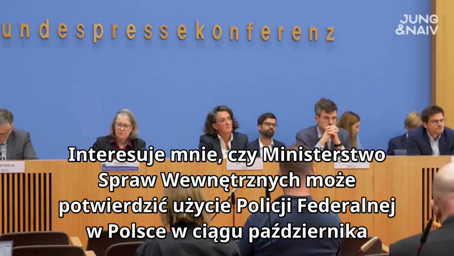 1:11 German Federal Police in Poland? Interior Ministry Responds
 1:48 Bus Fare Hikes, Transport Workers’ Wages and Guarantee Schemes
 iPhone app Translate videos on your iPhone Paste a TikTok, Instagram or X link, add subtitles in your language and save the video to Photos.

TranslateMom transcribes and translates videos from X, TikTok, YouTube and Instagram. Paste a link and you get a page like this one, in your language.