
Nanopontos de carbono na Coca-Cola e Pepsi: estudo e alegações sobre Gates
3 min Machine translated Health
3 min Machine translated Health
Isso, isso vai ser assustador para muita gente.
Há um estudo que descobriu que pontos de carbono fluorescentes em Coca- Cola e Pepsi atravessaram a barreira hematoencefálica.
Sim, o que isso significa é que, dentro da Coca-Cola e da Pepsi, um estudo analisou o líquido e identificou o que são chamados de pontos quânticos de carbono.
São partículas microscópicas, hum, com cinco nanômetros de largura, compostas de carbono, oxigênio e hidrogênio.
E, hum, o que também fizeram foi extraí-las da Coca-Cola e da Pepsi, e administrá-las a camundongos para ver o que aconteceria, e as partículas foram direto para o cérebro.
Então, elas atravessam a barreira hematoencefálica.
Elas passam por ela, então entram no cérebro.
Cheg- elas chegaram aos corações. Foram para o fígado e os pulmões.
Basicamente, foram para todo o corpo. E é aqui que a coisa fica muito estranha.
Bill Gates, Fundação Gates, é, é um dos maiores financiadores, um dos maiores investidores da maior engarrafadora de Coca- Cola do mundo, ah, fábrica de engarrafamento, ah, com 660 milhões de dólares investidos, além de ter financiado, ah, a PepsiCo.
Ele é um inves— era investidor nisso. E então, dois anos antes de detectarem esses pontos de carbono na Coca- Cola e na Pepsi, a Fundação Gates financiou um estudo que desenvolveu pontos de carbono.
O quê? Ah, é, não dá para inventar uma coisa dessas.
Acabei de descobrir isso. Eu pensei: «N- não tem como isso ser verdade.»
Ele, ah, diz na seção de agradecimentos: «Agradecemos à Fundação Bill& Melinda Gates por financiar este estudo.»
Eles literalmente produziram, ah, pontos quânticos de grafeno de carbono.
Ah, eles os fizeram de grafite. A questão é que, se você comparar os dois nanodots, os encontrados na Coke e na Pepsi, e os que a Fundação Gates ajudou a desenvolver, eles têm o mesmo tamanho, cinco nanômetros.
Ambos são fluorescentes e refletem luz, e têm a mesma composição química, basicamente carbono, hã, hidrogênio e oxigênio, e ambos têm o que chamamos de características grafíticas.
Isso significa que o carbono, as moléculas de carbono está disposto numa rede hexagonal, hã, nesses nanodots.
Então, basicamente, eles parecem iguais.
E não estou dizendo que os que ele desenvolveu dois anos antes estão na Coke e na Pepsi, mas estou dizendo, hã, que é uma coincidência muito estranha.
Sim, eu diria que é uma coincidência bem estranha.
E aqui está o estudo, aliás: nanopartículas fluorescentes presentes na Coca- Cola e na Pepsi- Cola.
End of transcript · 413 words · machine translated
This is, this is gonna be scary to a lot of people.
There's a study discovered that fluorescent carbon nanodots inside Coca-Cola and Pepsi that crossed the blood-brain barrier.
Yeah, what this means is inside of Coca-Cola and Pepsi, a study looked inside the liquid and identified what are called carbon nanodots.
These are microscopic, uh, five nanometer wide particles made up of carbon, oxygen, and hydrogen.
And, um, what they also did was they extracted them from the Coke and Pepsi, and they administered it to mice to see what would happen, and the particles went directly into the brain.
So it, it breaches the blood-brain barrier.
It goes through it, so it gets in the brain.
Get, it gi- got in the hearts. It went to the liver and lungs.
It basically went everywhere in the body.
And here's where it gets very strange. Bill Gates, Gates Foundation, has, is one of the largest funders, one of the largest investors in the world's largest Coca-Cola bottler, uh, bottling plant, uh, with $660 million invested,
as well as funded, uh, PepsiCo. He's an in- he was an investor in that.
And then two years before they detected these carbon nanodots in Coke and Pepsi, the Gates Foundation funded a study that developed carbon nanodots.
What? Uh, yeah, you can't make this up. I just uncovered this.
I was like, "Th- there's no way this is real."
He, uh, it says in the acknowledgment section, "We thank the Bill & Melinda Gates Foundation for funding this study."
They literally made, uh, carbon graphene nanodots.
Uh, they made it out of graphite. The thing is, you, if you compare the two nanodots, the ones found in the Coke and Pepsi, and the ones Gates Foundation helped develop, they're the same size, five nanometers.
They're both fluorescent and reflective, and they both have the same chemical makeup, basically, carbon, uh, hydrogen, and oxygen, and they both have what are called graphitic features.
That means the carbon, the carbon molecules are in a hexagonal, uh, lattice arrangement on these.
So they basically look the same. And so I'm not saying that the ones he developed two years earlier are in the Coke and Pepsi, but I am saying, uh, that's a very strange coincidence.
Yes, I would say that's a pretty strange coincidence.
And here's the study, by the way, fluorescent nanoparticles present in Coca-Cola and Pepsi-Cola.
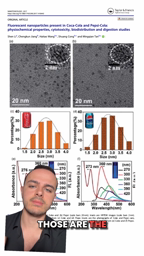 2:14 Estudo encontra nanopartículas de carbono na Coca-Cola e na Pepsi
 2:36 Alongamentos de pescoço sentados para quem trabalha no computador
 6:02 Oradora alega riscos reprodutivos em documentos sobre a vacina da Pfizer
 2:12 Participante questiona peptídeos, Ozempic e tratamentos injetáveis
 1:33 Luz vermelha e LEDs: possíveis efeitos nas mitocôndrias
 1:25 Suco de romã: alegados benefícios para o intestino, a pressão e a energia
 1:19 Dados da vacina da Pfizer e alegações sobre mortes notificadas
 2:01 Concerns Over COVID-19 Vaccine Risks
 1:37 Alegações sobre documentos da Pfizer e reações à vacina contra a COVID-19
 0:38 Enxaguante bucal, bactérias orais e pressão arterial
 0:46 OMS: crise climática é uma crise de saúde antes da COP31
 0:52 Raspadores de língua de cobre: alegações sobre bactérias e cura
 iPhone app Translate videos on your iPhone Paste a TikTok, Instagram or X link, add subtitles in your language and save the video to Photos.

TranslateMom transcribes and translates videos from X, TikTok, YouTube and Instagram. Paste a link and you get a page like this one, in your language.